
All articles
AI is Unlocking Hidden Capacity in Private Trucking Fleets, Boosting Broker Margins
Discover how AI solves trucking's empty-mile problem. Russell Jones explains how AI unlocks hidden capacity for freight brokers, boosting margins & fighting fraud.

Key Points
For freight brokers, accessing the vast, untapped capacity of empty private fleet trucks is challenging, but new AI-driven solutions are transforming this inefficiency into a crucial supply source.
Russell Jones, CEO of Private Fleet Net Zero, explains how his company uses proprietary data and AI to operationalize this hidden capacity for brokers.
The platform uses AI to absorb and process dynamic lane information, ensuring reliable matches that significantly increase broker margins and mitigate the growing risk of freight fraud.

We’re using AI to absorb dynamic lane information coming from brokers and carriers and bring it into our database. When you combine proprietary data with AI, that’s a very powerful business model.

Russell Jones
Nearly half of all trucks on U.S. highways belong to private fleets. Yet, a significant structural inefficiency means an estimated 80% return empty. The market's structure has perpetuated this inefficiency for decades. Private fleets prioritize repositioning trucks for their next internal load over generating backhaul revenue. Freight brokers, already contending with razor-thin margins, historically struggled to access this fragmented, conditional capacity. Now, new technology transforms empty capacity into a crucial supply source, offering efficiency and margin to an industry desperate for both.
Russell Jones, a serial SaaS founder known for scaling ventures in pioneering markets, architects one such solution. Growing his last company, Cargo Chief, to tens of millions in revenue, Jones pivoted to a SaaS model in his latest venture, Private Fleet Net Zero. A successful pilot with Amazon’s massive private fleet illuminated the true scale of the empty-backhaul problem. PFNZ acts as a matching layer between private fleets, dedicated fleets, and brokers. It uses first-party data and AI to operationalize backhaul availability without changing any party's underlying incentives.
"We’re using AI to absorb dynamic lane information coming from brokers and carriers and bring it into our database. When you combine proprietary data with AI, that’s a very powerful business model," he says.
The margin multiplier: And the model works. After just over a year in operation, the platform scaled to 40,000 lanes of coverage. It now handles tens of billions of dollars in registered freight spend from buyers. Rapid growth, validated by the successful pilot with Amazon's private fleet, demonstrates the model's effectiveness. Access to previously hidden capacity directly addresses the brokerage industry's razor-thin margins. "A private fleet's priority isn't maximizing revenue. It's getting its truck back for the next internal load," he explains. Because of this, fleets often haul freight at a discount, which can double or triple a broker's margin.
Beyond clear economic benefits, unlocking this latent capacity offers a significant environmental dividend. Filling an empty truck means one less truck dispatched, directly reducing fuel consumption and carbon emissions. Jones projects that filling just 10% of the nation's empty private fleet backhauls could result in an annual carbon reduction equivalent to 300 million trees.
Automate or evaporate: While the logistics industry is modernizing slowly, an economic reckoning now forces its hand. For many freight brokers, AI adoption is a near-term business imperative, as automation transforms logistics efficiency and challenges existing business models. Manual processes that once defined the industry yield to a widespread movement toward intelligent, agentic workflows that operate at a scale humans cannot match.
Reimagining the freight world: "For a typical freight brokerage, 40% of the staff might be carrier representatives. Artificial intelligence can replace that functionality," Jones says. He believes a third of employees will leave the freight brokerage world within the next few years. Jones adds, "All the brokers say, 'I need to get AI or I'm going to be out of the game in five years' time.' They are opening up their tech spend and re-engineering how they do things."
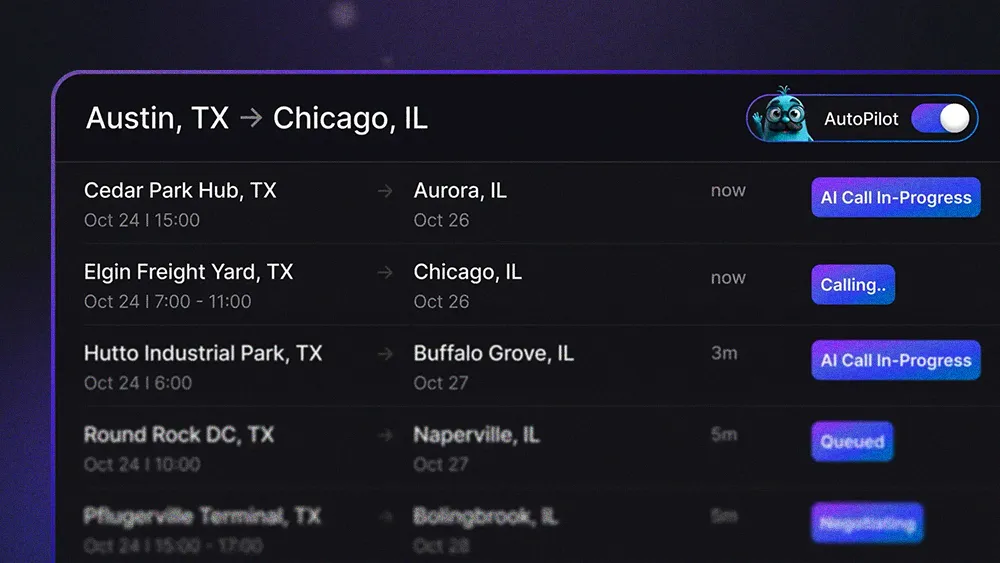
Jones explains his company uses AI to absorb dynamic lane information, normalize messy inputs, and generate viable matches at scale. When a carrier sends a message detailing upcoming availability on a specific lane, for example, the platform's AI absorbs, cleans, and integrates that information into the database to generate a precise match. Manual workflows simply cannot handle this task.
Meanwhile, automation accelerates against a backdrop of rising risk. The industry grapples with a surge in freight theft and fraud, a top-level concern. Bad actors target everything from food and beverage to electronics. First-party data integrity—knowing who you are really dealing with—becomes a core challenge.
A $30 billion problem: The industry's fragmented nature creates fertile ground for sophisticated crime, making trust a more valuable commodity. Jones states, "Freight theft and fraud is at an all-time high; it's the number one topic." He estimates a $30 billion domestic problem, with theft up 24% last year.
Playing games: Jones explains, "The world of freight brokerage is hyper-fragmented. There are something like 25,000 to 28,000 different brokers now, and that includes 'Bob in his mom's basement.'" He adds, "Every time new technology emerges to avoid fraud, the bad guys get clever and work around it. It's a cops and robbers game."
For leaders navigating this transition, Jones advises protecting core intellectual property and using specialized partners for commodity technologies. He explains, "Tasking an internal engineer with learning a new tool like ChatGPT from scratch is expensive. It takes time, and they likely won't get it right the first time." Instead, his company partnered with a large development house. The house brought in a ChatGPT specialist, delivering the project on time and on budget.
On market pressure: A post-COVID freight recession pressures inefficient players in the private fleet market. Meanwhile, a looming government crackdown on driver certification expects to create a capacity crunch, making AI-driven utilization a top priority. Jones states, "Because of the freight recession, larger brokers are becoming more automated and more efficient. Those brokers that don't adopt modern techniques to be more efficient are getting squeezed out."
Jones considers himself a realist. He admits the industry remains a laggard. Many brokers still dabble in AI and get impatient in the face of challenges with workflow integration, data quality, and human literacy. "You might have old-time truck drivers who resist talking to a robot, but they will miss out on opportunities and eventually be squeezed out," Jones says. "Think about it in real life: when you call your bank, you're dealing with a chatbot. United Airlines, American Airlines—that's just where we are in 2025. It's hard to escape it."
Automation, Jones clarifies, has clear boundaries. He notes AI excels at high-volume transactional work, freeing human capital for high-value strategic relationships. For the foreseeable future, a sales call to a major client like Anheuser-Busch remains a fundamentally human endeavor. Meanwhile, the routine task of ordering a truck on a digital load board stands as a prime candidate for automation.